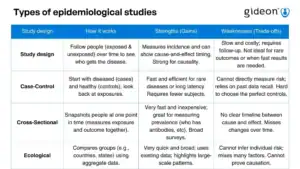
1. Ecological studies
An ecological study analyzes data at the group level (e.g., countries, states, cities) rather than the individual level. For example, it might compare COVID-19 death rates across countries with different mask policies.
Ecological studies typically use publicly available data or summaries, often over large regions or many populations.
Strengths
- Ecological studies are very fast and inexpensive since they use existing data (e.g, government reports)
- They can include many groups at once, revealing big-picture patterns (like how national lockdown timing relates to overall case curves)
- Such studies are useful for hypothesis generation
Weaknesses
- Ecological studies look at groups, not people
- It’s not certain that relationships seen across countries apply to individuals
- Many factors vary across regions (healthcare quality, culture, climate). So it’s easy to confuse correlation with causation
- The accuracy of case and death reports may differ across regions
What we gain: Very rapid, broad comparisons at a population scale.
What we lose: Precision and individual-level insight. In an outbreak, ecological analyses can quickly highlight national or regional trends, but they can’t prove that a policy or factor caused better or worse outcomes.
Example: Between 2016 and 2020, researchers in South Jakarta conducted an ecological time-series study. They wanted to explore how environmental conditions shaped outbreaks of dengue hemorrhagic fever (DHF). The study did not track individuals. Instead, it examined population-level patterns. Researchers compared monthly dengue case counts with city-wide climate and demographic data.
The analysis showed important connections. Spikes in DHF followed specific weather patterns. These patterns included heavy rainfall, high humidity, and warmer temperatures from about two months earlier. Areas with higher population density had more cases. Areas with higher numbers of Aedes mosquito larvae also recorded more cases.
This kind of study helps identify large-scale trends. It shows how weather and urban factors together influence disease transmission across a community. However, it cannot pinpoint which individuals are most at risk
2. Cross-sectional studies
A cross-sectional study takes a “snapshot” of a population at one point in time. It measures who was exposed and who has the outcome right now.
A cross-sectional study is like a survey asking people, “Do you have X now, and did you do Y in the past?”
Since exposure and outcome are collected simultaneously, this design is best for describing prevalence (how common something is) and for finding associations.
Strengths
- Cross-sectional studies are fast and relatively cheap
- They can include large, diverse samples (giving a big picture)
- They help estimate how widespread the infection, immunity, or symptoms are at a specific time
Weaknesses
- Cross-sectional studies can’t easily tell cause and effect, since it is not known if the exposure came before the outcome
- Such studies miss changes over time (no follow-up)
- If the study is done online or on mobile devices, it may bias the sample (e.g., more tech-savvy people respond)
- People who died or recovered quickly can be missed
- Some people may refuse to be tested or surveyed
What we gain: Quick estimates of current status (like antibody prevalence) for a whole community.
What we lose: Clarity on what led to those results. In outbreaks, cross-sectional studies can help with rapid surveillance but not with proving cause.
Example: A national cross-sectional survey in Niger tested children aged 6–59 months for malaria infection and assessed household factors.
The study found a malaria prevalence of 23.7% among tested children. Children from low- and middle-income households were ~50–64% more likely to be malaria-positive than those from high-income homes. In addition, those with mothers lacking formal education had ~2.5 times higher risk than those whose mothers had the highest education level. The study also found that urban children had ~69% lower malaria risk than children in rural areas.
Since the data was collected at a single point in time from a large group, it reflects a classic cross-sectional snapshot. It links exposure factors to how widespread the infection was.
3. Case-control studies
A case-control study looks back in time to compare the exposures of people with the disease (cases) and those without the disease (controls).
This is like asking, “What was different between those who got sick with cholera during the Haiti epidemic and those who did not?”
Strengths
- Case-control studies are efficient, especially for rare outcomes or when follow-up is hard
- They require a smaller sample and can be done relatively quickly
Weaknesses
- Case-control studies cannot directly measure incidence or risk
- Because the cases are picked first, it’s tricky to ensure that both cases and controls have the same chance of being exposed
- Sick people may remember (or report) past exposures differently from healthy controls
- Choosing controls poorly can distort the comparison (e.g., controls not truly from the same population as cases)
What we gain: Speed and simplicity, especially for studying causes of a specific outcome. In an outbreak, a case-control study can be conducted quickly to point to possible causes.
What we lose: Precise risk estimates. People might misremember exposures, and risks might be calculated incorrectly.
Example: During the 2017 chikungunya epidemic in Brazil, researchers used a matched case-control study. They wanted to identify factors associated with death from chikungunya.
The study found important results. Pre-existing chronic conditions were strongly associated with death. Chronic kidney disease increased the risk significantly. Other chronic heart diseases also increased the risk. Certain clinical symptoms during illness also raised the likelihood of fatal outcomes. These included fever, abdominal pain, apathy, dyspnea, and arthritis.
This study shows the utility of a case-control design. It helps identify risk factors for severe outcomes during an outbreak. Researchers were able to pinpoint both underlying comorbidities and acute clinical markers.
4. Cohort studies
A cohort study follows people over time to see how an exposure influences who becomes ill. This is like asking, “If two groups start healthy today and only one is exposed to a possible risk, who will go on to develop the disease?”
In a cohort study, the exposure isn’t necessarily the disease itself. It’s something suspected to increase the risk of developing the disease. For example, exposure might be a viral infection, a vaccine, a type of mosquito habitat, contaminated water, or even a behavior such as not using bed nets.
This design can be prospective (you enroll people now and follow them) or retrospective (you use existing records of a group who were exposed or not in the past).
Strengths
- Cohorts can directly measure how often an outcome happens (incidence)
- Can help link cause to effect
- Since individuals are tracked over time, it’s easier to see the time order of events (exposure before disease). This makes causal interpretation stronger
Weaknesses
- Cohort studies take time and resources. It can take years to get results, which can slow urgent responses
- Cohorts can also be expensive and require careful data collection over time
- People dropping out can skew results if those who leave are different from those who stay
- Other factors (like age or health) might influence both exposure and outcome, unless carefully measured and adjusted
What we gain: A clear timeline and strong evidence on risk factors
What we lose: Speed and cost-effectiveness. In outbreaks, cohorts can be too slow if fast answers are needed.
Example: A prospective cohort study published in 2025 followed 816 adults in Saudi Arabia with COVID-19 over 4 years. Researchers recorded who developed long COVID and who recovered.
They found interesting results: nearly 29% had persistent symptoms. And women, for example, were at an especially high risk of developing long COVID. People with diabetes were also at a very high risk.
This study design allowed authors to estimate long-term outcomes. It also helped them identify risk factors. However, it required years of follow-up.